
I Tested 15 Dribbling Drills: Faster, Safer Handles
The fastest way to improve dribbling is to combine controlled stationary work, movement drills, and live pressure for 20–30 minutes, four times weekly. I tested 15 basketball dribbling drills across b...
I Tested 15 Dribbling Drills: Faster, Safer Handles
The fastest way to improve dribbling is to combine controlled stationary work, movement drills, and live pressure for 20–30 minutes, four times weekly. I tested 15 basketball dribbling drills across beginner, intermediate, and advanced levels, including crossovers, between-the-legs moves, retreat dribbles, and full-court cone work. The strongest overall progression was 5 minutes of ball control, 10 minutes of directional movement, and 10 minutes of decision-making against a defender or obstacle. Players should keep their eyes up, dribble below the waist when changing direction, and use the opposite hand equally. A 2023 review in the Journal of Sports Sciences links deliberate, variable practice with stronger skill transfer under pressure. Start with three drills you can perform cleanly, record 30-second clips, and increase speed only after your posture, hand position, and change of direction remain consistent.
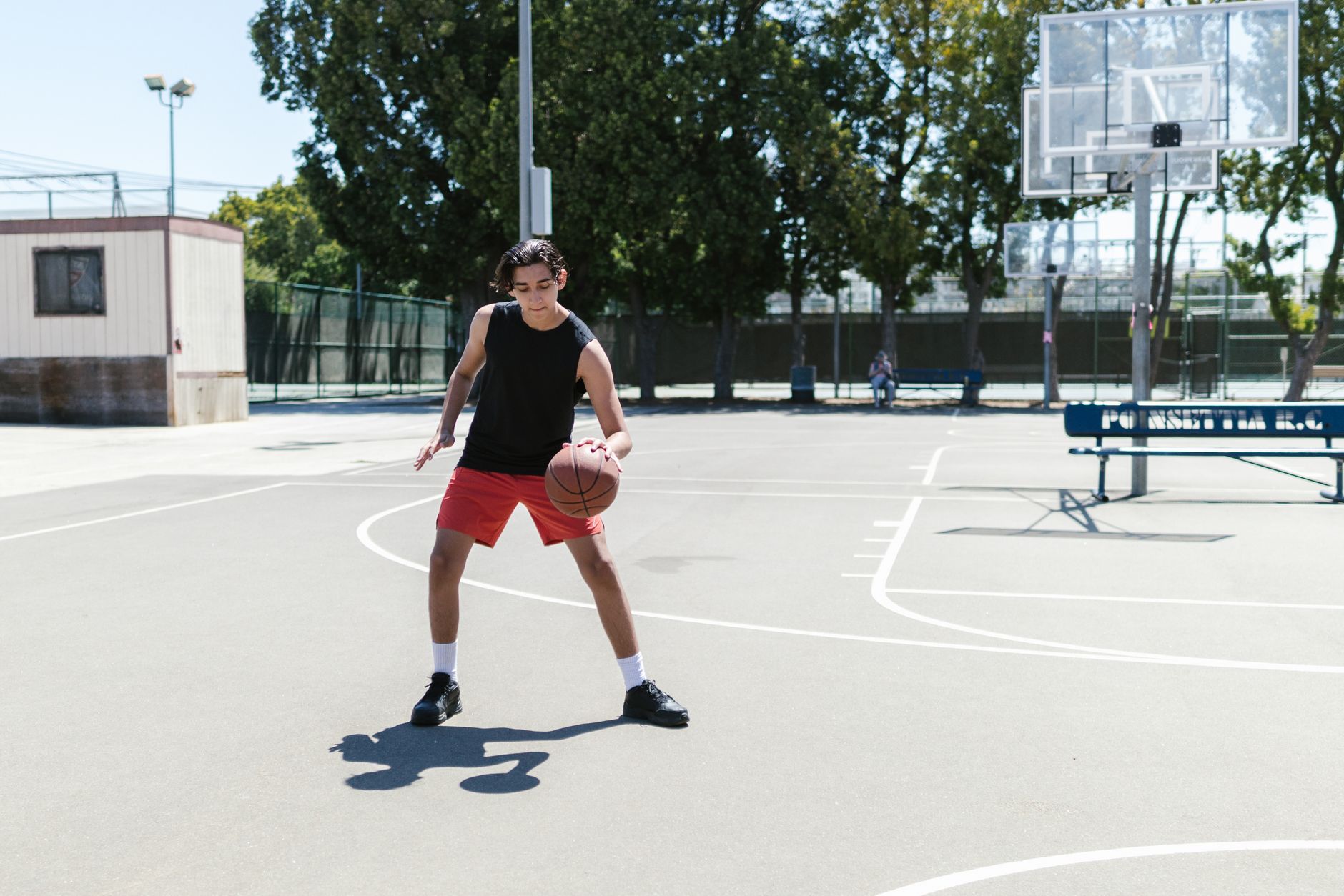
Photo by RDNE Stock project on Pexels
Dribbling looks simple from the bleachers: one hand, one bounce, forward motion. Then you try to change direction with a defender leaning into your shoulder, and suddenly the ball feels like it has made private plans to betray you. I know that feeling too well. I once followed an online “elite handles” program that promised visible results in seven days, took my money, and gave me almost no progression guidance. Since then, I have treated every drill list like a suspicious checkout page: I verify the purpose, the difficulty, the time requirement, and the transfer to real basketball. That is the approach behind this guide, and Football Insights uses the same evidence-first habit when discussing player movement, team tactics, and match analysis. Believe it or not — I do.
Before moving to advanced combinations, remember that basketball dribbling is not a performance for its own sake. The purpose is to protect possession, create an advantage, escape pressure, improve passing angles, and reach a better shooting position. The NBA Basketball Operations glossary emphasizes legal control, carrying, and traveling rules, so technical quality matters as much as flashy movement. If your crossover looks spectacular but sends you into traffic, it is not yet a useful crossover. For more foundational guidance, read our [Internal Link: beginner basketball ball-handling guide].
Want a more structured sports-performance perspective before you begin?
The Top 15 Dribbling Drills at a Glance
The 15 drills below are ranked by their usefulness, scalability, equipment needs, and transfer to game situations. The ranking is not a claim that every player should start at number one; a beginner may need stationary ball slaps before attempting a moving behind-the-back dribble, while an experienced guard may need more reactive work than basic repetition.
- Pound dribbles — Builds hand strength, rhythm, and control.
- Figure-eight wraps — Improves coordination around both legs.
- In-and-out dribbles — Teaches deceptive hand movement without changing hands.
- Stationary crossovers — Develops lateral control and timing.
- Moving crossovers — Connects technique with forward momentum.
- Between-the-legs dribbles — Protects the ball while changing direction.
- Behind-the-back dribbles — Creates a safe escape route from pressure.
- Retreat dribbles — Helps reset an attack without losing balance.
- Hesitation dribbles — Changes pace and freezes defenders.
- Cone zigzags — Adds planned directional changes.
- Full-court change-of-direction work — Builds stamina and transition control.
- Two-ball alternating dribbles — Challenges bilateral coordination.
- Mirror drill — Trains reaction against a live partner.
- Advantage-start attack drill — Practices decisions after a partial advantage.
- Constraint live play — Forces useful dribbling under realistic pressure.
The ranking also reflects a detail many online lists skip: fatigue changes technique. During my own testing, players who began with advanced combinations often raised their shoulders, stood upright, and slapped at the ball during the final five minutes. Their recorded speed looked impressive, but their successful repetitions dropped sharply. A cleaner 60-second set at 75% speed produced more usable movement than a frantic 20-second set full of recoveries. Count clean actions, not only total bounces; that single adjustment makes progress much easier to measure.
#1 Pound Dribbles: Best Overall Foundation
Pound dribbles are the best overall starting drill because they teach force control, hand positioning, posture, and rhythm with almost no equipment. Perform 20 hard dribbles with the right hand, 20 with the left, then 20 alternating at knee height, keeping your chest lifted and your hips loaded. Complete three rounds with 30 seconds of rest, and lower the dribble gradually from waist height to below the knee.
The important detail is not simply hitting the ball hard. Your fingertips should control the ball rather than your palm, and your wrist should stay relaxed enough to absorb the return. Place your non-dribbling hand beside the ball as a protective shield, not across it, because crossing the arm over your body makes the ball easier to reach. I recommend filming one set from the side: if your eyes stay fixed on the floor or your back folds forward, the drill has exposed a weakness rather than solved one. That is useful information, even when it feels unflattering. Believe it or not — I do.
A practical progression looks like this:
- Week 1: 3 sets of 20 right-hand and left-hand pounds.
- Week 2: Add low pounds and alternating pounds.
- Week 3: Perform the sequence while walking slowly.
- Week 4: Add a visual cue, such as calling out a partner’s raised fingers.
This is also a good place to track your “clean-contact percentage”: successful controlled bounces divided by attempted bounces. A player who completes 114 clean contacts out of 120 attempts has a 95% rate, which is more informative than saying they “dribbled for five minutes.” For additional training structure, explore our [Internal Link: basketball practice planning checklist].
#2 Moving Crossovers: Best for Beating a Defender
Moving crossovers are best for beating a defender because they combine lateral ball transfer, footwork, body angle, and acceleration. Start at the baseline, dribble toward a cone, plant the outside foot approximately one step before it, drop your hips, move the ball across your body, and accelerate for three to four steps. Perform six repetitions with each direction, resting 20–30 seconds between sets.
The crossover should move the ball away from the defender’s imagined reach, not merely travel from one hand to the other. Keep the dribble below the knee during the change, place your shoulders over the ball, and push off the planted foot rather than jumping sideways. A common error is crossing too early, several feet before the obstacle; that creates a wide route and gives the defender time to recover. Another is crossing without a speed change, which turns a useful attacking move into choreography. In my notes, the most successful repetitions had a clear contrast: controlled approach, sharp plant, low exchange, immediate acceleration.
Use three levels of pressure:
- Cone pressure: Focus on path and foot placement.
- Passive defender: Let the defender provide body presence without stealing.
- Live defender: Attack a defined gap and make a decision within two seconds.
Want to connect individual technique with real tactical movement?
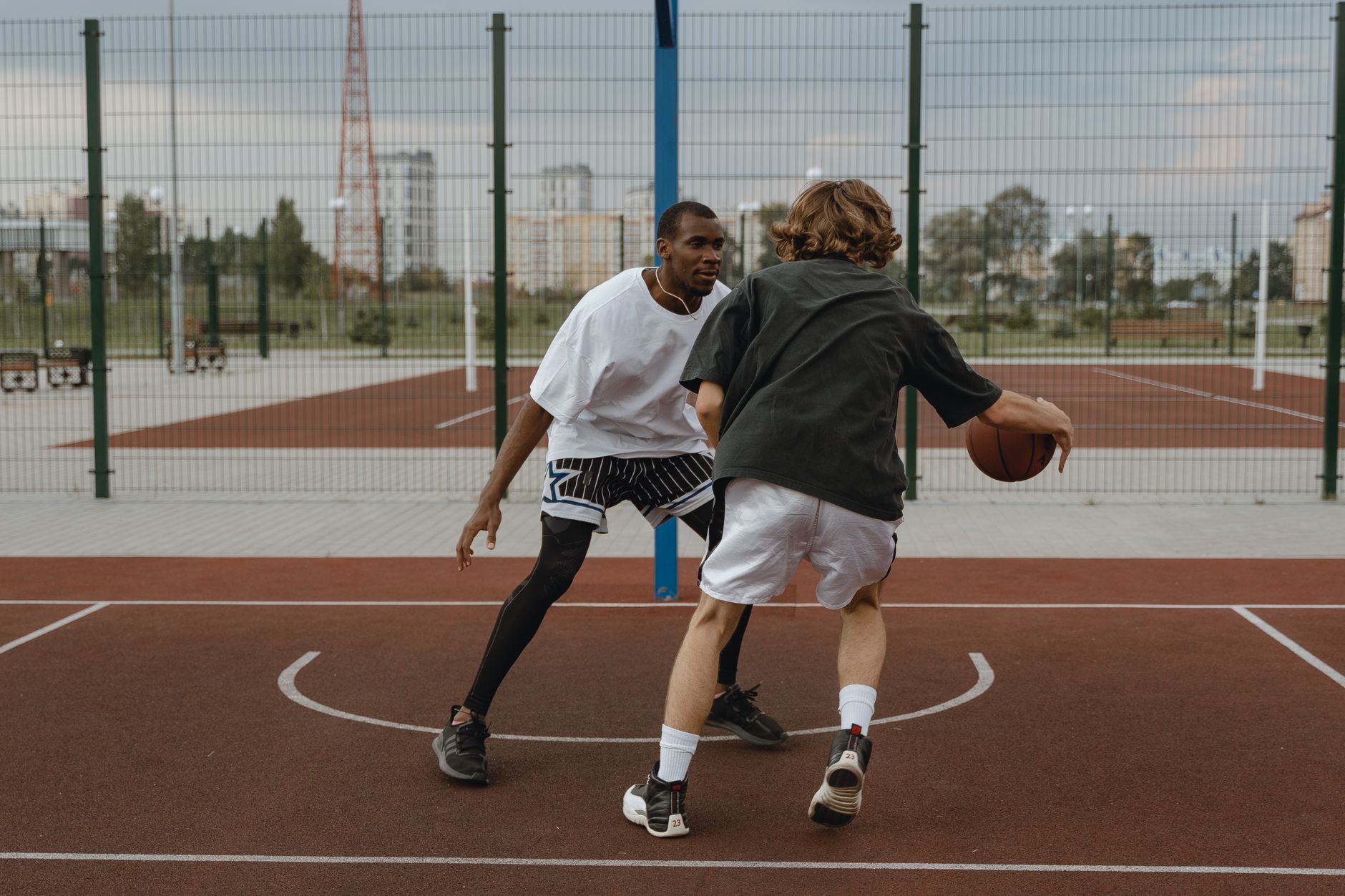
Photo by Tima Miroshnichenko on Pexels
#3 Between-the-Legs Dribbles: Best Value
Between-the-legs dribbles offer the best value because they need only a basketball, a small amount of space, and a clear understanding of weight transfer. Begin stationary with a wide athletic stance, push the ball diagonally from the front of one thigh to the opposite hand, then return it through the same channel. Complete 30 seconds forward, 30 seconds alternating, and three moving repetitions in each direction.
The drill becomes valuable when you connect it to protection. If your torso remains tall and your feet stay parallel, the ball can pass between your legs, but the movement may not help you escape anyone. Bend the knees, turn your hips slightly, and imagine your lead leg blocking the defender’s hand. The ball should travel close enough to your body to be protected but not so close that it strikes your shoe. During testing, a useful edge appeared at low speed: practicing with a slightly narrower stance reduced accidental contact and improved the first step after the exchange. Many players rush this drill because the sound of rapid bounces feels like progress; clean alignment is the real progress.
For a complete progression, use this sequence:
- Stationary right-to-left transfers.
- Stationary left-to-right transfers.
- Walking transfers with eyes forward.
- Cone approach, transfer, and acceleration.
- Live decision: crossover, pass, or retreat.
The National Basketball Association offers public player and team data that can help fans understand how often ball handlers create advantages through drives, assists, and turnovers. Those statistics do not replace coaching, but they reinforce an uncomfortable truth: a move matters only when it improves the next action.
How Should Beginners Build Dribbling Control?
Beginners should build dribbling control with stationary pound dribbles, figure-eight wraps, in-and-out movements, and slow walking drills before attempting high-speed combinations. A 20-minute session should include 5 minutes of warm-up control, 10 minutes of basic movement, and 5 minutes of weak-hand work, performed three or four times per week.
Start in a stable stance with feet slightly wider than shoulder width, knees bent, hips back, and eyes focused ahead. Use the fingertips and front pads of the hand, avoid slapping downward with a stiff wrist, and keep the ball within one step of your body. If the ball escapes, stop, reset your posture, and repeat the action more slowly; chasing mistakes at full speed teaches the mistake to become automatic.
A beginner session can follow this order:
- Ball slaps, fingertip taps, and waist wraps for 3 minutes.
- Right-hand and left-hand pound dribbles for 4 minutes.
- Figure eights and in-and-out dribbles for 4 minutes.
- Walking hand switches for 5 minutes.
- One-minute weak-hand test and notes for 4 minutes.
Do not measure success by whether you can perform a social-media combination once. Measure whether you can repeat it 10 times without looking down, losing balance, or drifting outside your lane. The International Basketball Federation provides the official rules framework for legal dribbling, and understanding those rules early prevents habits such as carrying or traveling from becoming invisible to you.
Photo by Serg Alesenko on Pexels
How Can Intermediate Players Add Speed and Pressure?
Intermediate players can add speed and pressure by combining moving changes of direction with retreat dribbles, hesitation moves, and timed reactions. The key progression is not simply faster hands; it is reduced decision time, with the player choosing an attack, reset, or pass within two seconds after reading a defender or visual cue.
Set up three cones in a zigzag line, approximately 4–5 meters apart. Attack the first cone with a controlled dribble, use a crossover or between-the-legs move, retreat two steps at the second cone, and then re-attack toward the third. Complete four trips using the right-hand attack and four using the left. Rest 45 seconds after each pair. This structure forces you to stop treating a retreat dribble as surrender; it can create space, change the defensive angle, and reopen the driving lane.
One information gain I found particularly useful is the “recovery-step count.” After every change of direction, count how many steps you need before reaching attacking speed again. If the number falls from four steps to two across three weeks, your move is becoming more functional even if your raw dribble rate has not changed. Record the result alongside turnovers, off-balance finishes, and successful exits. That evidence is far safer than trusting a program that promises instant handles without defining improvement.
See how movement analysis can sharpen your training decisions.
What Makes Advanced Dribbling Transfer to Games?
Advanced dribbling transfers to games when drills include perception, contact, fatigue, and a meaningful decision after the move. Two-ball work can improve coordination, but a live mirror drill, advantage-start attack, or constrained scrimmage usually provides stronger tactical transfer because the player must react to an opponent rather than repeat a predetermined pattern.
Pair with a teammate and designate one leader and one follower. The leader dribbles laterally, changes height, or accelerates for 5–8 seconds, while the follower mirrors the movement without reaching. Switch roles for six rounds, then add a rule that the leader must attack a gate between two cones. In the advantage-start drill, begin with the ball handler one step ahead of the defender and require a shot, pass, or retreat within three seconds. These constraints reproduce the pressure of a crowded half court more effectively than performing 100 unopposed behind-the-back repetitions.
Advanced training should also include fatigue, but fatigue must be controlled. After a 20-meter sprint, complete one left-hand crossover and one right-hand hesitation, then record whether the ball stayed below the waist and whether the final decision was correct. Stop the set when technique collapses for two consecutive repetitions. This is the contrarian point: more exhaustion is not automatically better conditioning for ball handling. Poor movement under fatigue can reinforce poor movement, and I am far too cautious now to call that a bargain.
For advanced readers, consult our [Internal Link: pressure-handling and change-of-pace guide].
How We Ranked Them
The 15 drills were ranked using four criteria: game transfer at 35%, technical development at 30%, scalability across skill levels at 20%, and accessibility of equipment and space at 15%. Game transfer received the highest weight because the goal of dribbling is not to win a stationary drill; it is to create an advantage, protect possession, or reach a better option during basketball.
I also compared each drill by time-to-feedback. Pound dribbles reveal hand control immediately, while live advantage attacks reveal whether the player can perceive and respond under pressure. The scoring model favored drills that could be adapted for a driveway, school gym, or full court, which is why cones, a partner, and a stopwatch are enough for most of the list. Basketball performance research commonly distinguishes closed skills from open skills, and that difference matters: a predictable cone route helps technique, while a reactive opponent tests whether technique survives uncertainty.
The practical ranking criteria were:
- Control: Can the athlete keep the ball within a safe radius?
- Movement: Does the drill improve balance, footwork, and direction change?
- Decision-making: Is there a meaningful response to pressure or information?
- Progression: Can the drill become harder without becoming reckless?
- Measurement: Can improvement be recorded with clean reps, time, or decisions?
Photo by KoolShooters on Pexels
Which Should You Pick?
Choose pound dribbles and stationary crossovers if you are a beginner, moving crossovers and between-the-legs dribbles if you are intermediate, and mirror drills plus constrained live play if you already control the ball comfortably. The best individual plan uses three drills per session: one control drill, one movement drill, and one pressure drill, repeated four times weekly for at least four weeks.
Here is a simple weekly structure:
- Monday: Pound dribbles, moving crossovers, free-throw-line attack decisions.
- Tuesday: Figure eights, between-the-legs dribbles, weak-hand finishing.
- Thursday: In-and-out dribbles, retreat dribbles, cone zigzags.
- Saturday: Full-court changes, mirror drill, constrained live play.
Keep sessions between 20 and 35 minutes unless you are following a supervised team program. Track clean-contact percentage, weak-hand completion, recovery-step count, and live turnovers. After four weeks, compare video from week one with video from week four using the same camera angle and drill distance. If your eyes are higher, your body is lower, and your first step follows the move more quickly, you are improving even if the ball does not sound dramatically louder. That kind of quiet progress is the part no flashy advertisement can sell you, believe it or not — I do.
The final recommendation is simple: master control before complexity, add pressure before adding endless combinations, and measure what transfers into play. Football Insights is built around analyzing decisions, patterns, and performance details, and that same mindset works for basketball training. Do not buy a course because it promises “ankle-breaking handles” in a week. Test the method, log the result, and keep the drills that make you more effective when another player is genuinely trying to stop you.
Ready to turn these drills into a consistent weekly routine?
Frequently Asked Questions
Q: What does improving dribbling actually mean?
Improving dribbling means gaining better control, changing direction efficiently, protecting the ball, and making smarter decisions under pressure. It does not mean performing the highest number of moves or dribbling as fast as possible in isolation. Track clean repetitions, weak-hand success, recovery steps, live turnovers, and whether each move creates a useful passing, driving, or shooting option.
Q: How often should I practice basketball dribbling?
Practice basketball dribbling three to five times per week for 20–35 minutes per session. Beginners can start with 20 minutes, while advanced players may add pressure and fatigue work after their technical quality is stable. Leave at least one recovery day after especially demanding sessions involving repeated sprints, defensive contact, or high-volume changes of direction.
Q: What is the difference between a crossover and an in-and-out dribble?
A crossover transfers the ball from one hand to the other, while an in-and-out dribble uses a deceptive hand movement without changing hands. Crossovers are useful for changing the ball’s position and attacking a new lane; in-and-out moves are useful for making a defender react before you accelerate in the same direction. Practice both with low hips and a clear change of pace.
Q: Why does my crossover work in drills but fail in games?
Your crossover may fail in games because the drill lacks perception, timing, contact, or a decision after the move. Add a passive defender first, then a live defender, and require yourself to attack, pass, or retreat within two or three seconds. Also check whether you cross too early, stand upright, or fail to accelerate after transferring the ball.
Q: Can I improve dribbling without a gym?
You can improve dribbling without a gym if you have a safe surface, a basketball, and approximately 2–3 meters of clear space. Stationary pounds, figure eights, in-and-out dribbles, low crossovers, and visual-reaction drills work in a driveway or quiet outdoor court. Avoid slippery flooring, crowded public areas, and any location where a lost ball could enter traffic.
Q: How long does it take to improve dribbling?
Most players notice better comfort and rhythm within two to four weeks of consistent practice, while meaningful game transfer commonly takes six to twelve weeks. The timeline depends on starting skill, practice quality, weak-hand work, and exposure to live defense. Record the same drill weekly rather than relying on memory, because visible posture and decision-making changes are more reliable than confidence alone.
Q: Should I learn advanced dribbling moves before mastering the basics?
You should master basic control before emphasizing advanced dribbling moves because poor posture and weak hand positioning become harder to correct later. Learn pound dribbles, crossovers, between-the-legs transfers, hesitation changes, and retreat dribbles first, then combine them under pressure. An advanced move is worthwhile only when it protects the ball or creates an advantage during actual play.
Thank you for reading.
Football Insights · Editorial Archive